June 9th, 2013 / Author: G.L. Breedon
Created by AcademicEarth.org
Ray Bradbury‘s Fahrenheit 451 is one of my favorite dystopian novels (Brave New World is probably my favorite).
The video above is a nice little synopsis of the novel and it’s major themes. The entire book encapsulated in 2 minutes and 35 seconds. Like a whole meal in tablet form from the Jetsons. Its creator sent me the link and asked me to share, which I encourage everyone else to do as well.
The video got me to thinking about the novel and thinking about reading it again. I can’t remember if I read it when I was 13 when I read 1984 and Brave New World for the first time, or whether I read it later, possibly in college. However, one of the nice things about having too many books (which really means I don’t have enough book shelves) is that I was able to find a copy in less than a minute.
It also got be thinking about Bradbury as a writer of short seminal novels – Fahrenheit 541, Martian Chronicles, Something Wicked This Way Comes, and Dandelion Wine. Technically Martian Chronicles and Dandelion Wine are unified short story collections, but the thought that occurred to me is that these novel are an inspiration to a new writer like myself – to create something that is not simply entertaining, but a lasting work that that will speak to readers about core human issue decades in the future.
So, in the interest of inspiring myself, I’ll add 451 to the top of the reading pile and the film to the movie queue. Below is a little collage of the novel’s covers I created for fun. I always think it interesting to see how a popular novel’s cover changes over time, reflecting the design ideas popular culture at the time.

May 14th, 2013 / Author: G.L. Breedon

There were a couple interesting articles this last week at io9 and at Slate addressing the question of whether or not Religion and Science and be reconciled. The explicit conclusion of the Slate article by physicist Sean Carroll is that they are not. The comments to both articles seem, in general, to agree.
Carroll’s article is mostly about why he won’t take money from the Templeton Foundation, but links to an earlier blog post about why he feels Science and Religion are not compatible.
A key quote:
“The reason why science and religion are actually incompatible is that, in the real world, they reach incompatible conclusions. It’s worth noting that this incompatibility is perfectly evident to any fair-minded person who cares to look. Different religions make very different claims, but they typically end up saying things like “God made the universe in six days” or “Jesus died and was resurrected” or “Moses parted the red sea” or “dead souls are reincarnated in accordance with their karmic burden.” And science says: none of that is true. So there you go, incompatibility.”
Needless to say, this got me thinking (not for the first time) about the relationship between Science and Religion.
While I agree with everything Carroll wrote in his blog, I find I disagree with his conclusion. He, and most folks, think of Religion as a whole thing, rather than being made up of several constituent aspects, some of which, I believe, are compatible with Science.
Off the top of my head I think you could at least subdivide any religion into the aspects of Mythology, Theology, Ritual, Ethics, Spirituality, and Mysticism.
Mythology is the stories that a particular religion tells about the world and its founders. If these stories have no historical or provable component, they require Faith (yes with a capital F). The Mythology of Region is not compatible with Science. Science requires proof for belief, and always remains willing to change it’s mind. Mythology must be taken on Faith.
Theology is the way the myths are interpreted and how doctrine is explained and defined over time. Theology changes, but myths do not. Here, as with Mythology, there can be little compatibility with Science. Theology generally seeks to reinforce the founding beliefs espoused by Mythology and give them legitimacy through philosophical rationalization, rather than empirical evidence. One proves the existence of a supreme being that created the universe with Theology, but not with Science (unless some better evidence to the contrary arises at some point).
Ritual is the way a religion is expressed in practice — the liturgy, prayers, and practices that comprise the collective and individual worship. That final word — worship — is the key indicator that Ritual is not compatible with Science. There simply isn’t any overlap between Ritual and Science.
Ethics, the moral values and injunctions that a religion promulgates, are usually thought of as the purview of philosophy, but I think that the Science can study ethics. Certainly psychologists study the ethical development of humans and sociologists and anthropologist can study the ethical behaviors of different societies around the world and throughout history. While these fields are not what is typically thought of as “hard” science, they all make use of the scientific method to establish facts about the human world.
Spirituality, the intentional cultivation of peaceful states of mind like love, compassion, patience, and equanimity, is another aspect of Religion that I think can be compatible with Science, in particular, psychology. Psychologists can and do study different states of mind, the means for achieving them, and their affects on individuals and communities.
Lastly, Mysticism, by which I mean the meditative practices for achieving deep states of conscious awareness in which perceptions about the nature of reality are heightened or altered, can potentially be an aspect of Religion that is compatible with Science. Mysticism is an inner practice of examining the Ultimate Nature of Reality, an area Science leaves to physics. Certainly psychologists and neuroscientists can examine the brains of meditators who are claiming to have a non-normal perception of reality, but this does not prove that this perception — of the non-dual nature of reality espoused by Buddhists (Emptiness), Hindus (Brahman), or Jewish, Christian, and Muslim mystics (Godhead) — is accurate and factual. We can argue that our normal perceptions are “proven” by collective agreement, i.e. if enough people say the sky is blue, it is likely to be blue. A similar claim is made by interspiritual mystics, that if thousands of people have preformed the same experiment (meditation) and obtained a similar result (a non-dual perception of reality), then this perception can be taken as at least a provisionally accurate description of the full nature of reality. Proving this perception through the science of physics is a more complicated matter.
Integral philosopher Ken Wilber has cautioned against hitching one’s mysticism to physics, because as the physics of the day changes, one must either readjust one’s mysticism to match, or give up the association. New Age seekers have spent decades pointing to the ‘non-intuitive conclusions of quantum physics’ (to borrow a phrase from Carroll’s blog post), to suggest that mystical perceptions of reality are in fact scientifically founded. However, String Theory (‘theory’ being a poor word choice), assuming it can ever proceed to an actual experimental stage of development, might upend the conclusions of mystics. As might whatever the cutting edge physics is a hundred years from now.
This doesn’t men that we should not use Science to investigate Mysticism. While it doesn’t make sense to try and match up mystic perceptions of the ‘Ultimate Nature of Reality’ with hand picked theories from physics, it also doesn’t make sense to wall off Mysticism and Science. To me, Science and Mysticism are compatible because Science can explore, in both mathematical and experimental manners, the perceptions that are presented by Mysticism. In the same way that Science and look at the wavelength of the light reflecting from the sky and tell us that it is what we typically label the color ‘blue,’ Science can also examine the claims about the non-dual nature of reality to determine if it is merely a perceptual bias (seeing what we expect to see) generated by slowly altering the neural connections of the human brain, or if it has a basis in fact and is an accurate description of the universe. (As a side note, see physicist David Bohm‘s work on what he refers to as the Implicate and Explicate Orders of reality.)
This is actually what I think the mission of the Templeton Foundation is aiming at, and for which I think Carroll might reconsider his self imposed ban on Templeton funding. His presumption is that the perceptions of mystics about the Ultimate Nature of Reality are fantasies, but the science to investigate them has not really been done yet.
I think I might also add the additional area of the Supernatural, although it is not strictly as aspect of Religion. Science tends to disregard any “supernatural” phenomenon as errors in perception with no basis in fact or reality. Whether it’s ghosts or precognition or telepathy, the presumption is that these are artifacts of imaginative minds.
Simply because a phenomenon is non-repeatable, does not mean it did not take place. In fact, I tend to think of many supernatural phenomenon as ‘non-repeatable unique expressions of reality.’ In other words, we may not have the science to explain something that has happened, and a perceived event may not be entirely a product of the perceiver’s imagination and perceptual bias. I have personally had several experiences that defy any explanation by physics as we understand it now. However, I do not attempt to reach conclusions about these events, or foist upon them some supernatural ‘explanation’ because doing so doesn’t help me find the truth of what I experienced. Seeking the truth of such non-repeatable unique expressions of reality should be done with a scientific approach involving investigation, hypothesis, and experiment.
So, while I agree that some aspects of Religion are not compatible with Science (Mythology, Theology, and Ritual), I do think that others clearly are (Ethics, Spirituality, Mysticism). I also think that Supernatural phenomenon need the investigation by Science to better understand how these non-repeatable unique expressions of reality can so frequently flaunt the commonly understood laws of physics.
And that is enough deep thinking for the day!
May 2nd, 2013 / Author: G.L. Breedon

Storytelling is not easy. I know this because I see and read bad story telling all the time. It’s no easy task to create an interesting idea with an exciting plot and engaging characters. I’ve decided that a fun blog post might be listing off the things I’ve learned from the well written stories I’ve read and watched lately. It might even be something I do regularly.
(It probably goes without saying, but spoilers will follow)
Things I Learned Watching Alias
- If your story has a central character – make sure your character stays central to your story. My wife and I recently discovered Alias and Netflix. We watched all five seasons in a little over a month. Yes, we enjoy binge viewing. I found that, while having subplots for the secondary characters was enjoyable, the more the story drifted from Sydney, the less fun and engaging the overall story tended to be. This was especially true in the final season where new characters were introduced and ate up too much screen time. I realize the writers needed to work around Jennifer Garner being pregnant, but they could have taken a few lessons from The X-Files episodes where Gillian Anderson was pregnant. Just because she can’t do the fight scenes doesn’t mean you need to find a stand in. Let it be an opportunity for her character to do other things. Lesson: Know who your story is about and keep it that way unless there is a good reason to change the character focus.
- Make sure your McGuffin (or central mystery) has a real pay off – and that it doesn’t stretch believability too far. The whole Rambaldi stuff annoyed me. I found that the episodes that dealt with real world issues (WMDs, terrorists, etc.) were much more engaging than all of the Rambaldi storylines. And I would normally love this kind of thing. But it’s like too much ice cream. A cone worth is tasty, a quart can make you sick. Most annoying was the gut feeling that none of it mattered because the central question of Rambaldi (how this guy could invent/channel all this science and technology 500 years ago) was going to remain unanswered. The quest was always about finding another Rambaldi artifact rather than finding out who Rambaldi was and how he did these amazing things. To me, the man Rambaldi was more interesting than the artifacts he created, much in the way Da Vinci the man will always be more interesting than his art and inventions. To me at least. Lesson: McGuffins can have a nasty bite if note feed properly.
- A single central mystery McGuffin for a story series needs to be large enough to last the entire story cycle if it is going to be the main focus. Oh how I hoped with the beginning of each season that the Rambaldi storyline would be forgotten. But no. It kept coming back like a bad basement mold. A convenient crutch so the characters would have one more quest to go on, one more artifact to obtain, like some endless video game. Lesson: McGuffins can die if not fed properly.
- Don’t be afraid to kill off the villain and get a new one. There was no reason to keep Sloan along as the villain for all those seasons. Shifting loyalties are interesting to explore in a series. For instance, I love how the writers of Farscape dealt with the changing motivations and loyalties of Craise and Scorpius. With Sloan however, there was the added problem of believability. The CIA would never let him run an operation. He would always pose a security risk. And I could never believe that Sydney would be in the same room as Sloan after DS6 was taken down. But the real problem is that since his main motivation was Rambaldi, he never really felt threatening enough. Self-interested, yes. Dangerous, yes. But he always seemed more like a deranged art collector willing to kill for the final piece for his collection. Lesson: If your villain stops being interesting your heroine will stop being interesting as well.

Things I Learned Watching The Walking Dead and Revolution
- The writers of Revolution should spend more time watching The Walking Dead. I know, that’s a bit snarky. Actually, the writers of Revolution should spend more time reading S.M. Stirling’s Dies the Fire and Emberverse books. The lesson being that writing a show around a mystery is very hard to do. Lost is a clear success but there are many failures (The Event, Flashforward, etc.). The reason that Lost succeeded (or at least got renewed long enough to finish its story) is because the mystery was wrapped up with the character development. It’s hard to care about the answer to a mystery, but it’s easy to care about characters. Which is why I enjoy The Walking Dead. There isn’t much emphasis on the mystery of why zombies have taken over the world. That’s not as important as what is happening to the people who are trying to survive the zombie apocalypse. Lesson: Mystery is great for hooking the audience, but to keep them engaged you need engaging characters with struggles people care about.
- As a side note, I think this is why many people were unsatisfied with the ending of Lost. The writers made two mistakes. First, they gave too much emphasis to the mysteries, so some people thought they were watching a show about mysteries and not characters. And second, they let people think they were watching a show with mysteries that would have science fiction answers rather than mystical-fantasy answers. Lesson: Be clear what kind of story you are telling.

Things I Learned Reading The Twelve
- Flashback are not easy. Justine Cronin is very good at writing flashbacks. But he does’t call them that. Instead he writes his flashbacks as a 180 page prologue. Which sort of works, but distances us from the characters in the future who we have been waiting to spend time with since the end of The Passage. That novel also had a long prologue (300 pages) set at the end of the world rather than 90 years later where the rest of the novel takes place. In The Twelve, he also has us spend a lot of time with characters in the past who will end up dead and who will not be tied to the story in the future. Which makes me wonder why I spend 100 pages reading about them. Lesson: If you want to keep people engaged in the story and characters, cut between the individual stories, past and present, more frequently. And make sure it’s clear why you are telling a character’s story, especially if they end up dead and we never see them again.
That’s enough for now. Hopefully I can actually take these lessons to heart and make my own storytelling stronger.
April 18th, 2013 / Author: G.L. Breedon

I learned a few days ago that visionary architect Paolo Soleri passed away on April 10th at age 93. I’ve posted about Soleri before. I first encountered his ideas in 1979 while watching an episode of 60 minutes when I was ten years old. Shortly after that I came across and article about him in Future Life Magazine.
Soleri was a philosopher architect with a deeply spiritual worldview. He studied briefly with Frank Lloyd Wright but soon followed his own unique path, creating the concept of an arcology, a single structure city that combines the design of architecture with the holism of ecology. His basic idea was that we didn’t need to keep building cities that sprawled all over nature but could instead build massive single structure cities that sprawled upward into the sky.
He started building an experimental example of an arcology, called Arcosanti, in 1970, in Arizona. I visited it once, many years ago. What impressed me most was that it seemed to have been brought into existence through an act of extraordinary will power on Soleri’s part. I’m curious, and a little trepidatious, to consider what might happen to the nascent town in his absence. I find his passing make me sad, not simply because his very important ideas may never find fruition, but because I was so affected, and infected, by those ideas as a young boy.
Of course, I couldn’t really understand the philosophy behind those ideas when I was 10. I remember struggling to fathom Soleri’s The Omega Seed: An Eschatological Hypothesis when I read it in my 20s. It explored the underpinnings of his philosophy, deeply influenced by the writings of Pierre Teilhard De Chardin, and was not the easy read I had hoped for. The titles of his books relay their intentions. The Bridge between Matter & Spirit Is Matter Becoming Spirit is one such slender tome.

They are wonderful books for engaging the mind in deeply considering the future of humanity and of how humanity lives, but it was his books of designs for arcologies, Arcology: City in the Image of Man, that really excited my imagination. His mandala-like designs filled me with a sense of wonder and awe and hope and joy. Reading the book was like delving into some arcane volume of occult esoterica – like an architectual Voynich manuscript translated English.
It is difficult to fully describe Soleri’s ideas. His writing is deep, tangled, and mercurial, but like his Jesuit inspiration, well worth the effort. The design of arcologies is structured around Tielhard de Chardin’s notion of complexification, which suggests an arrow of complexity in evolution from wider, less complex states to smaller, more complex states.
Soleri writes, “If the city is an organism made of all the intricate interaction of bodies physically peripatetic and demanding, mentally diffuse and willful, then the city can only find a reasonable chance for success within the same rules disciplining any other living phenomenon: The rule of duration of complexification and miniaturization.”[i] Ken Wilber refers to this as greater depth, less span, and it finds expression everywhere in nature, from living cells to the human brain.
As cultural historian William Irwin Thompson explains, “For, Soleri this process of complexification linked with minaturization is the lesson the city planner should take away from the study of nature. In evolution, simplicity is always linked to complexity; while huge dinosaurs lumber into extinction, tiny mammals chatter in the trees. Soleri would say it is much the same with our cities now. The huge megalopolitan beasts are sprawling all over the Earth… They so fill their ecological niche that they destroy it, and thus become caught in their own evolutionary dead end.”[ii] In contrast, Soleri’s designs for cities are not only Integral in their need for balance with the environment, they also explicitly explore the full range of human needs, from social connection and community, to work, play, and spirituality.
At present Arcosanti, designed for some 5000 people, is only five percent complete and has fewer than a hundred residents. The reason for this lack of progress is not due to Soleri’s micromanagement, as some critics would have it, nor to the general apathy of the public toward such a grand vision. It is rather, I believe, the result of the fact that such a centralized project is difficult to create without a great amount of centralized funding and control, such as would come from a government or an exceptionally large corporation. This problem can be resolved by appealing to decentralized techniques that are tied to a central, yet flexible, plan. There are excellent reasons for us to adopt arcologies as the model for our future cities, especially in crowded developing nations, but their physical enormity makes this nearly impossible with traditional organizational techniques.

Below is article from Future Life Magazine (issue #8, February 1979) that first intrigued me. I’ve also listed some quotes from Soleri’s work. Hopefully you’ll find it all as inspiring as I some thirty five years ago.
Soleri Quotes:
“Economic incentive is not a realistic guideline to the intricacies and the mystery of life.”
Paolo Soleri, Archology: The City in the Image of Man, Part I, Chapter 6
“Man is faced with the following syllogism: (1) The city is the cradle and the expression of civilization, and (2) materialistic society has all but destroyed the city. Thus, (1) materialism is foreclosing man’s destiny, and (2) the city is a nonmaterialistic phenomenon, it follows that a speculative (business) attack on the urban problem is devoid of the fundamental power the solution demands, i.e., the care of a nonspeculative commitment. As speculation is, or was, instrumental for wealth, that which is not instrumental to it, but is rather its user, is that which is committed beyond speculative aims. Speculation can be instrumental to the city. It cannot be its aim.”
Paolo Soleri, Archology: The City in the Image of Man, Part I, Chapter 5
“Materialism is a pathology of technology. It is not technology as many bright minds utter confidently. More precisely, materialism is the pathology of a society that, unable to discriminate between feasibility and desirability, takes the road of less resistance and drowns life in a sea of per se innocent, re-ordained mineral stuff. It is a shopping center, psyche bugging, collective mesmerizing alchemical tunnel with no visible light at the end. “
Paolo Soleri, Technology as Cosmogenesis, p. 5
April 7th, 2013 / Author: G.L. Breedon

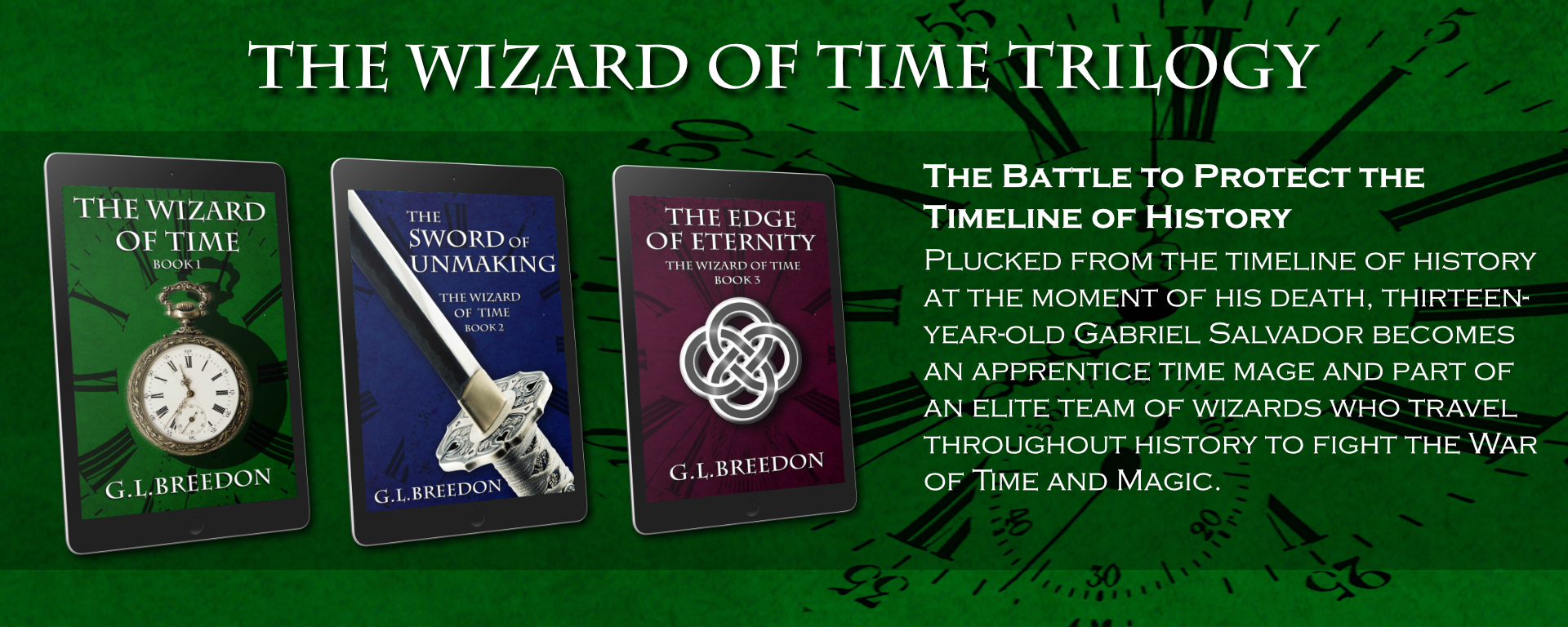
The Sword of Unmaking (The Wizard of Time – Book 2) is now available at Amazon!
Nearly a year after being snatched from the timeline of history at the moment of his death and revealed to be the Seventh True Mage, Gabriel is deeply involved in fighting the War of Time and Magic.
Shortly after he and the Chimera team return from a near-disastrous extraction mission to save a mage in ancient Vienna, the battlefield comes to Windsor Castle.
In the midst of defending the castle, Gabriel is thrust into a wild chase through time to recover a coded notebook that may be the key to saving the Primary Continuum from destruction.
Gabriel’s quest takes him places he never imagined, and forces him to make choices with consequences he cannot avoid, in order to rescue his friends, the castle, and the timeline of history itself from the mad plans of the Dark Mage, Apollyon.
March 30th, 2013 / Author: G.L. Breedon

It’s been a long while since my last blog. The day job and the work to finish WOT #2 have kept me too busy (and to be honest I haven’t really had a good idea for a blog of late).
The good news is that The Sword of Unmaking (The Wizard of Time – Book 2) is finally finished.
As a thank you to fans of the first book who have been patiently waiting for the sequel, I’m giving out Advance Reader Copies of the ebook from now until the book goes live (hopefully the week of April 7th).
So, if you are interested in receiving a copy of The Sword of Unmaking before it is officially published, simply send an email request to:
WOT2 @ Kosmosaicbooks.com.
As the ebook will only be available on Amazon for now, if you need an epub version, please indicate that.
The blurb for the book is below. Hope you enjoy the read.
Nearly a year after being snatched from the timeline of history at the moment of his death and revealed to be the Seventh True Mage, Gabriel is deeply involved in fighting the War of Time and Magic.
Shortly after he and the Chimera team return from a near-disastrous extraction mission to save a mage in ancient Vienna, the battlefield comes to Windsor Castle.
In the midst of defending the castle, Gabriel is thrust into a wild chase through time to recover a coded notebook that may be the key to saving the Primary Continuum from destruction.
Gabriel’s quest takes him places he never imagined, and forces him to make choices with consequences he cannot avoid, in order to rescue his friends, the castle, and the timeline of history itself from the mad plans of the Dark Mage, Apollyon.
January 31st, 2013 / Author: G.L. Breedon

(Note: this post is assembled from parts of a book I once wrote about spirituality and globalization. I thought it might be interesting to share)
“I see the Cybiont as a single planetary organism, and, more specifically, as the most advanced form of a planetary brain now coming into being.” Joel de Rosnay, The Symbiotic Man, p. 114
The idea of a Cybiont world is a combination of the Gaia hypothesis, the ever-increasing network of computer technology around the world, and the potential advent of artificial intelligence, or something closely resembling it. The Cybiont supposition is that in some ways we are adding a “brain” to the “body” of the living system of the Earth. This is a farfetched idea, but one that will become progressively more plausible as the 21st century marches onward. As our world becomes more and more interconnected at every level by ubiquitous computing, a nonlinear network is being created.
As communication throughout this network comes under the control of computers that are as powerful as human brains, what might the result be? What is the implication of artificial intelligence for a single computer and how does that implication magnify when it is networked with millions or billions of other computers, some equally powerful, some less powerful, and some even more powerful? When smart chips and nanoprobes are spread throughout the world feeding information into this network like so many nerve endings, how will it respond? Is there the possibility of a leap in complexity to a higher order? Might not this network become adaptive?
These are questions we should considered in the coming decades, because this network, which we are creating, will inevitably have effects on the human species and the physical, non-cyber world, of living beings. While we may not be able to predict the effects of this Cybiont we might be creating, if we are attuned to the changes that emerge during its early development, we might have some chance of guiding its “evolution” toward our continued benefit. If this emerging “brain” develops a “mind” of its own, we will want to be sure that this mind is somewhat in agreement with ours about the sanctity of life and humanity in particular.
It seems unlikely, but then again, we must ask ourselves, what is it that allows us humans to have the experience of consciousness we do when other organisms have little or none? The level of complexity of our brain, and in particular its size in proportion to body weight, seems the only real candidate. Thus, at some point there are enough neurons to allow a deeper experience of consciousness. This number seems to be around ten billion, a number than many futurists assume would create striking change if our world population were to reach it. But how many connections between computers are needed to create such a leap in complexity? The answer is unknown, however it is easy to guess that ten billion would be in the right neighborhood.
At the heart of this notion of a Cybiont world is the idea of artificial intelligence (AI). AI is not truly necessary for a Cybiont world to arise, any more than it is necessary for each neuron of the brain to be aware in order for the whole brain to achieve awareness. Some AI research is based on the notion that if you can create a computer with as many or more possible connections as a human brain, then it will be possible to create a human-like intelligence. The research for this seems to be headed in two directions, the first being to program a computer to have this intelligence, and the second being to create systems that are capable of learning, much like our brains, and letting them “grow” into human–like awareness. Though the second path seems a better bet, they are both, in my opinion, operating from a limited idea of consciousness.
While it may be possible to create a computer system that can mimic human intelligence, consciousness is another beast. Firstly, our experience of consciousness is dependent upon the fact that we have a body, not just a brain. Our body very much affects the way we experience consciousness. A double martini or a good kiss will testify to this. The only way we can hope to grant computers as powerful as human brains something like our awareness of consciousness is by also granting them bodies.
Assuming we can place a computer as powerful as a human brain in a robot whose “body” is as full of sensory input as ours, might we then foster non-living consciousness? Possibly. But then how will that consciousness develop? We know that our own experience of consciousness develops through several clear stages associated with the creation and maintenance of an ego-self. Would a computer-based-person move through these same stages? Would a computer mind naturally develop an ego-self? And if one did, what are the odds that it might then pass through the stages of personal development and move on to the transpersonal stages? Could a computer-based awareness of consciousness gain a spiritual experience of the kosmos? And since this consciousness would seemingly not be bound by the time constraints placed on living beings, how might its consciousness continue to develop thereafter? Moreover, could this program-person then be downloaded into other robots?
And what about the transhumanist and extropian movements that seek to merge the human consciousness with machine being? They want to transcend the limitations of the human body by transferring their minds and their experience of consciousness into machines that can live for nearly unlimited periods of time. They see humanity as merely one evolutionary stage in the greater evolution of intelligence. They see humanity as merely one evolutionary stage in the greater evolution of intelligence. Their hope is that advances in technology will allow individual minds to exist in perpetuity.
Of course the desirability of having a mind that is not in a human body isn’t something that appeals to everyone. And mystics would surely be amused at the idea of continuing the mind, the ego-self, for all eternity, as this is what keeps us separated from the direct and ultimate experience of reality. But even if the dreams of transhumanism can be realized, will they be realized for all humanity, or will only the wealthy and the privileged gain immortality in artificial bodies? What becomes of a society where those in power can remain in power indefinitely? Currently the transhumaist and extropian movements seem to be rooted in a thoroughly Modern worldview, but certainly there is the possibility that if their goals are achieved that minds possessed of Spiritual worldviews could make the leap to near eternal machine life. Might it then be possible for Bodhisattva transhumanists to perpetually help other “living” beings attain Enlightenment?
When it comes to subjects like the possibility of a Cybiont world, artificial intelligence, and extropian visions of trans-humanity, it is difficult to imagine not only how these things might affect us, but in some cases, how they will even come into existence. No technology, no matter how powerful, will change our lives for the better without a conscious effort to guide it toward that end. Simply increasing computing power and placing smart chips on everything will not give us more freedom or happiness. We will have to actively seek to mold these technologies to our needs, individually, locally, nationally, and globally.
We can only do this if we are aware if what these technologies are, how they are advancing, and how they are being implemented. Usually a technology is implemented by the company that stands to profit from its deployment with as little public discussion as possible. Whether the technology benefits society, or only the company’s profit margin, is generally of little concern. As computer and robotic technology continues to develop we should begin thinking about their implementation in society in Integral terms, addressing the long-term consequences with equal or greater care than we apply to considering the short-term benefits. We need to apply a human lens to our assessment of technology. John Naisbitt, in his book High Tech, High Touch, see this as “…embracing technology that preserves our humanness and rejecting technology that intrudes upon it.” This is a simple vision, but one that will be difficult to bring into focus without a strong commitment from each of us to strive for an Integral view of our technological future.
January 8th, 2013 / Author: G.L. Breedon

http://www.dccomics.com/
(These thoughts follow on from my previous post one remakes.)
Wonder Woman (TV)
I know a TV remake of Wonder Woman is being worked on even as a film project is being contemplated. And I’ve seen the monstrosity of a TV pilot David E. Kelley cooked up. Obviously, Hollywood has some trouble figuring out how to tell Wonder Woman’s story.
Again, as with Superman, I would start with the premise that Wonder Woman is a bit older than we’ve seen her in the past. However old the character is, she should be played by an actor who is in her mid-thirties at least. I know that’s problematic for Hollywood. Woman are supposed to quietly retire from acting at age 30 so male producers can fill the non-motherly roles with the new crop of 20 year old actresses.
Wonder Woman’s back story is important and I would go the Fung Fu / Lost route and have the backstory told in flashbacks that thematically relate to the story of the episode. Maybe these flashbacks could take place during her youth and a younger actress could be cast for these scenes (allowing male Hollywood producers to feel assuaged).
One of the problems I had with Kelley’s TV pilot is that there seemed to be this desire to turn Wonder Woman into “just a regular gal” – lonely and wounded. Blah.
Wonder Woman might be lonely, but she’s never a “just a regular gal.” Wonder Woman is always the most interesting, dynamic, and powerful person in the room. Let that be why she feels alone – set apart – not because she can’t find a man.
It reminds me of Jack’s tattoo on Lost. “He walks amongst us, but he is not one of us.” That’s Wonder Woman in a nutshell.
As for a romantic interest, make sure she’s got a man. An exceptional man. I like the idea of her being old, but looking younger. As I suggested for Superman, I’d have her story start in the 1940s. Steve Trevor was the love of her life then and he’s been long dead. Give her a new love of her life. A scientist/explorer maybe. A modern day Indiana Jones. Maybe they are even thinking about having a family. Maybe they have a son or daughter. It would be interesting to see Wonder Woman in the role of mother. Maybe she has to pretended to disappear to protect her child and some great evil villain arrives on the scene and brings her out of seclusion.
And rather than a new villain every week, I’d suggest a two part season, with 12 episode story arcs, each dealing with a new villain. What villains?
What villains indeed. There are plenty of good Wonder Woman villains to base a series of episodes around. Doctor Psycho, Aires, Veronica Cale, or The Duke of Deception to name a few. And a new series would be a perfect time to introduce new villains.
If you’re a Wonder Woman fan, you have this documentary to look forward to until someone figures out a film or TV version.

http://www.fanpop.com/fans/Superkevy11
Star Trek (TV)
I found J.J. Abrams’ remake of Star Trek to be surprisingly compelling. When I first read of the idea to retell the story from the point of the crew of the Enterprise while they were all still young and at Starfleet Academy, I had visions of “90210 in Space!” While the idea originated in the 80s, fortunately taking the storyline back before the beginning of the original gave the typical origins retelling a fresh take, helped of course, by changing history and creating and alternate timeline for it to play out in.
For a TV remake, which would really be more of a continuation, I have rather different ideas.
First, I would set it in the future – 100 years after the end of Star Trek Voyager. And I would take some lessons from shows like Fringe, and Lost, and the reimagined Battlestar Galactica. The Star Trek TV series have always focused on stand alone stories for each episode. Yes there are some long story arcs, especially in Deep Space Nine, but for the most part each episode stands apart.
I would suggest single season story arcs, or depending on how complicated it got, maybe extending it to two seasons. For a first story arc, maybe a massive generation ship arrives from deep space, fleeing a powerful entity that has destroyed its galaxy. An entity that has followed these new aliens to our galaxy and now threatens Star Fleet allies and enemies alike.
Each episode would deal with the main plot and then have a subplot that served a two-fold purpose. Each subplot would focus on a character, or a small team of characters, giving them more depth, while at the same time exploring some interesting problem or question where science (fiction) and morality/ethics/culture intersect – which is what Star Trek was always so good at.
Also, the tradition in Star Trek has always been for the story to center on one story arena, usually a star ship (DS9 being an exception). I think the story should take places in three arenas – a starship and its crew, a colony outpost, and a team assigned to the alien generation ship.
This kind of structure allows for some really interesting and expansive storytelling. It’s also very difficult. It would require an exceptionally talented writing and production team.
January 1st, 2013 / Author: G.L. Breedon

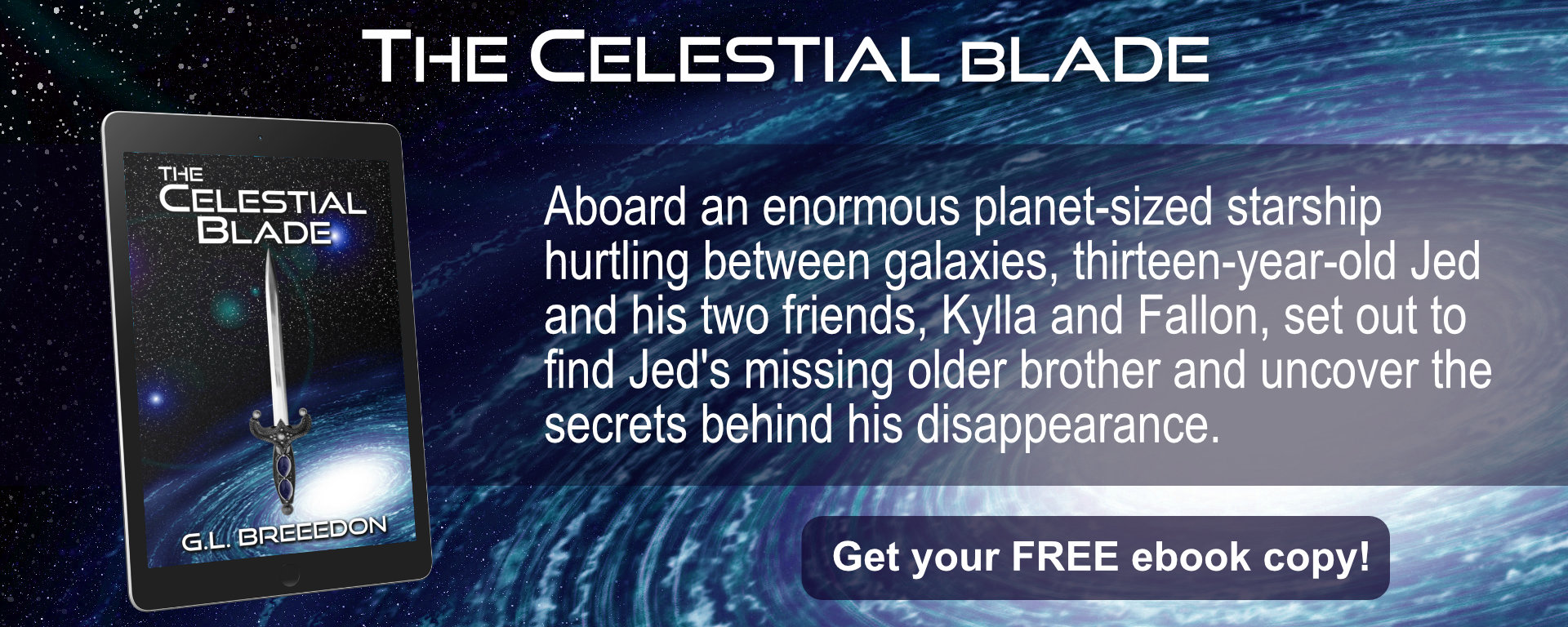
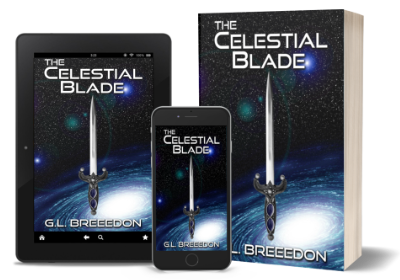
The Celestial Blade is finally available for sale!
The Celestial Blade is the first novel I wrote, but it took me a while to find the time to go back and edit it. It’s only available as an ebook on Amazon for the time being and will be out in print next week.
A synopsis is below:
The Celestial Blade
Aboard an enormous planet-sized starship hurtling between galaxies, thirteen-year-old Jed and his two friends, Kylla and Fallon, set out to find Jed’s missing older brother and uncover the secrets behind his disappearance.
Raised in a secluded valley where people have abandoned all technology beyond horse drawn wagons and simple tools, Jed and his friends venture out into the astonishing world of the massive starship, encountering strange cultures, technological wonders, and dangerous creatures.
Aided by an ancient dagger with mysterious powers that they recovered from a local castle and guided by elderly woman priest, they must track down Jed’s brother and save him from a mutinous rebel group known as the Iron Hand.
December 12th, 2012 / Author: G.L. Breedon
image source: kryptonradio.com
I’ve been thinking for a while about the redundancy factor in film and television, especially where sci-fi is concerned. Hollywood has always had an addiction to remakes (now called reboots to sound more modern I suppose). How could producers turn away from the idea of making a movie a second time if it was successful the first time. Give the story a fresh coat of paint and a few new faces and new audiences will be just as charmed as old audiences. Heck, even Hitchcock did it.
Lately, it seems there are so many remakes that they have become a genre unto themselves. Spiderman got a remake because… well, I’m not exactly sure why. The studio didn’t like the idea of Spiderman being in his 30s and Toby McGuire is not the fresh face he used to be? Because the third film in the franchise didn’t perform as well as the studio had hoped? This seems to be the reason for the remake of the remake of Superman. Apparently Brian Singer’s 2006 Superman Returns cost $270 million to make and only grossed $390 million. $110 million in profit is not enough (especially when prints and advertising will cut that in half – at least). One might think the Warner Bros. studio would concluded that maybe they could spend less on the sequel and make more in profit, but they instead concluded to start over again with a new director and new actor and (I assume) tell the story from the beginning one more time.
I think the “let’s tell the story from the beginning one more time” is the part that bothers me most about remakes – especially with franchises that are well developed. I recently saw The Amazing Spider-Man and I found it to be fairly entertaining. However, I kept thinking that it would have been more entertaining if I wasn’t watching the same story I had seen in the first Spider-Man movie not so long ago.
This got me to wondering why authors don’t seem to remake their novels? Would fans read remade novels? Would new fans read the old versions? The idea reminds me of the trend to novelize films that are based on novels. So, for instance there is a novelization of the film John Carter based on the novel The Princess of Mars. Weird. However, if J.K. Rowling were to decide in ten years that she wanted to retell the whole Harry Potter saga one more time with a fresh take and new character, I’m sure people would line up at midnight the day it came out.
All these thoughts about remakes got me thinking about what sci-fi and fantasy movies and TV shows I would remake and how I would try to retell the stories. Below are the first three of what I hope will be many.
(Mild disclaimer: While some of my fantasizing about remakes involves comic book characters and series, I am by no means a comic book fan/geek. I have a passing acquaintance with some comic book characters and series from TV and movies, but I’ve never spent much time reading them. When I was young, comics were frowned on in my family. I never found myself much attracted to them anyway. I’ve always loved words. My thinking as a kid was “why read something that last ten minutes when I can read a 600 page sci-fi novel for days?” So, these remake ideas are more about storytelling then comic book cannon.)
Remakes Ideas for Superman (film)
I know. It’s been remade after being remade and is being remade again. That’s why I figure it’s safe to daydreaming about remaking it soon once more.
The biggest problem I have with remakes of series (or franchises as they say in corporate lingo), particularly ones that are very well known, is the tendency to give the audience an origin story all over again. As I said, this bothered me about The Amazing Spider-Man. I found it less annoying in Batman Begins, but honestly, I wouldn’t have minded skipping all the backstory and starting with the adventure and the villain. This is one of the things I like about Superman Returns. While there were origin story flashbacks, there was no significant time spent telling the audience the story they already knew so well.
Here’s my thinking about origin stories – If it is a character that is well known, we probably all know the origin story and don’t need to see it detailed exhaustively. Fans will know the origin story and the folks who are not fans really won’t care all that much if you keep them interested with the story you should be telling.
So, in my remake of Superman, I would avoid any origin story at all. Clark Kent is an alien from Krypton, but that’s it. However, I would deal with his first years as Superman. But I would set those years when Clark Kent began being Superman in the late 1930s and early 1940s. Maybe even some of the WWII years. This storyline would then dovetail with a second storyline set in the present. Part of the idea is to show how Superman is not like those he cares for, not simply because he is more powerful, but because he lives longer. All or most of his friends and loved ones (Lois Lane!) will be dead by the time of the story set in the present.
And this brings me to one of the things I like best about this idea – while Superman ages more slowly, he still ages. He can be played by a man in his late 30s or 40s. With the right casting, this means Superman could be played by an actor with a bit of gravitas who projects some world weariness. Don’t ask me who. Hugh Jackman might be a good choice if he wasn’t so well associated with another comic book character.
The villain in the two stories (1940s & present) should be different but related. Maybe Lex Luthor on the 1940s and some completely new villain in the present. There are plenty of Superman villains who have not made it to the screen, but there is something to be said for giving the audience a nemesis they have never heard of before. Maybe Lex Luthor is developing a weapon in the 40s that he wants to use to rule the world. Maybe a wave device that destroys matter by neutralizing the nuclear bonds at an atomic level. Superman stops him of course. And maybe in the present there is another alien who has arrived (who maybe actually looks a little an alien) and wants to use the earth as a new colony. Because it’s cheaper and quicker to steal a world that terraform it. And maybe Superman needs to find this weapon he destroyed to use it to defeat the aliens.
The important thing for me is how a much older Superman would allow for greater depth in character development.
(More remake ideas to come.)
|
|